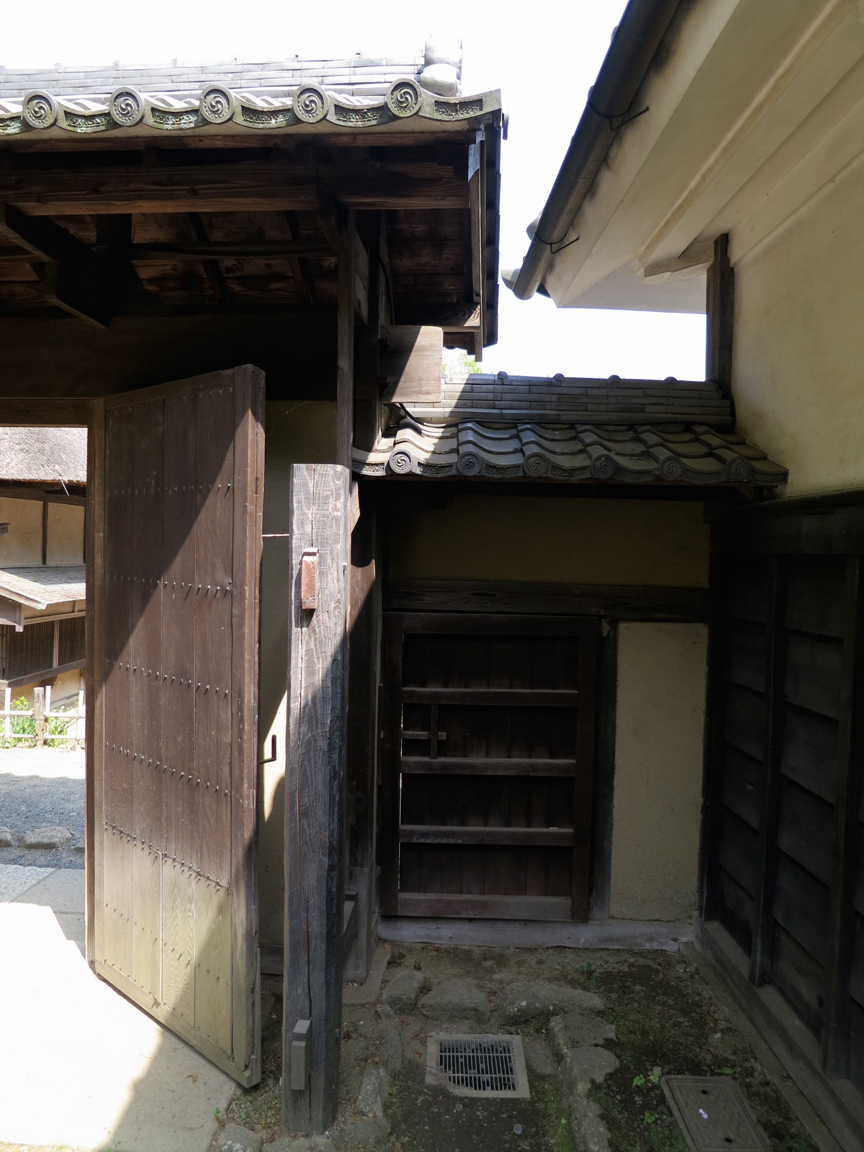
Wow, people were totally troll-size back in the days before homogenized vitamin D milk! Check out the tiny gate in this old wall!
No, wait. Then why is there an eensy-weensy gate next to the car entrance at this temple in Daimon? It was built after the war, when hamburgers and milk had already invaded Japan and made all the kids’ uniform pants too short. Is this a temple dedicated to short people?

Actually, none of the above. These gates have been built less than person-height on purpose, so everyone has to bow as they enter. Whether you’re the emperor or the guy who’s arrived to take out the garbage, you have to humble yourself before entering the sacred ground beyond.
Many garden huts built for tea ceremony have the same small doors, emphasizing that you have to leave your worldly status behind when performing tea ceremony.
And just for fun, here are the eleven strangest shrines in Tokyo, with all the inside scoop on the resident gods’ superpowers. One of them is at Nishiarai Daishi temple!
•
If you enjoyed this, subscribe! It’s free!
Would you like to be whisked away to Japan, wherever you are?


“The Samurai’s Octopus…is a truly remarkable book, one that surprised and charmed me at every turn of the page. You’re in for a treat.”
—James Ziskin, Anthony, Barry, and Macavity Award-winning author of the Ellie Stone mysteries
•
If you enjoyed this, subscribe! It’s free!
•

Jonelle Patrick writes novels set in Japan, produces the monthly e-magazine Japanagram, and blogs at Only In Japan and The Tokyo Guide I Wish I’d Had


I was going to guess “doggie gate” but that would have been wrong.
What does it say about me that I actually thought “trade entrance” at first!
In Pennsylvania where I am living, we have small windows and small gates too, and is because wood was not cheap years ago, so they were using any piece of wood available. And probably was not only the size of the people but the cost of the material.
I love the Minka-en, been there many times. One pointer: Avoid it in July and August. The thatch REALLY stinks in summer.
Yow, what does it smell like?
Actually, after being there the other day, I came home and had to wash my hair before I could go to sleep! It smelled like I’d been sitting around a campfire all day because they had fires going in some of the houses. An artist I know who lives in a village of them outside Kyoto told me that if you don’t regularly burn charcoal in the hearth, bugs totally invade the thatch. Ewww.
Ewww.
It’s hard to describe. Maybe moldy sports socks stuffed with Limburger cheese mixed with rancid mouse droppings. Avoid it. Trust me.
Ah, Asia. Ya gotta love the bugs.
Yes, these houses were meant to be lived in. The near perpetual fire in the main room would have kept the thatch in a prime condition. Thatch doesn’t work well for museum style applications in humid countries like Japan. I think there is one in Kawasaki that has a fire going at least during day time, it doesn’t smell at all and there are no bugs even in the summer. Lovely place!